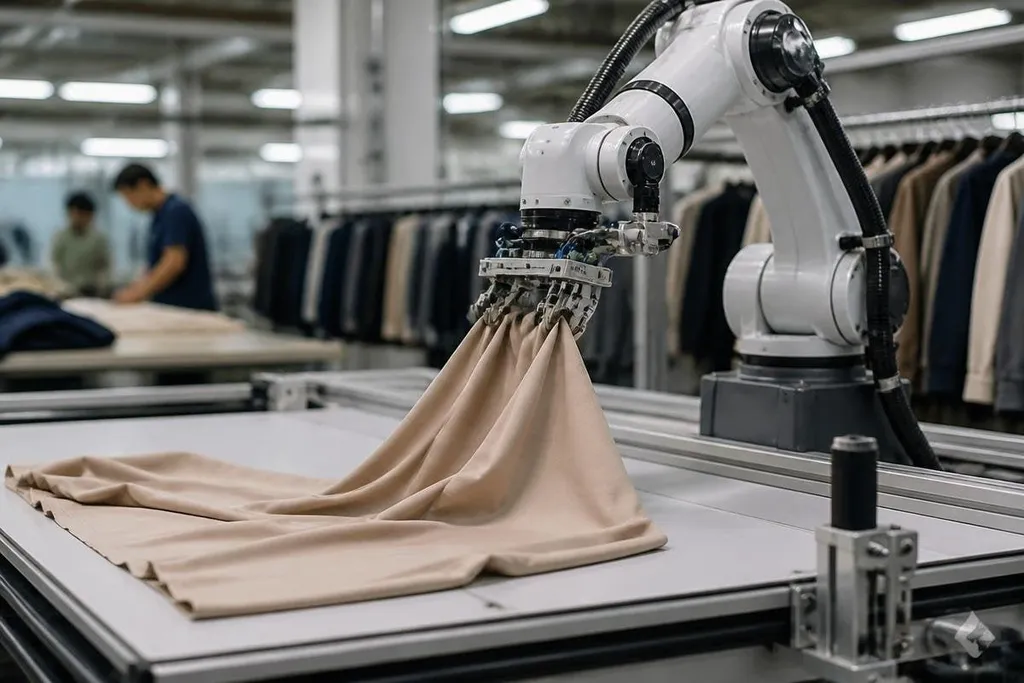
A robot that moves fabric in a video may look ready for a clothing line. That clip doesn’t tell you how it handles thin cloth, changing shapes, long shifts, or a jammed machine. Without verified examples, no honest list can rank major results in fashion robotics.
For now, the useful question is which claims deserve closer checking.
- Factory output matters more than a staged movement.
- Fabric handling is harder to judge than metal-part handling.
- A useful system needs clear limits, service details, and cost data.
What counts as progress
Fashion work includes cutting, sorting, folding, sewing, inspection, packing, and moving parts between stations. Each task gives a robot a different problem, so a claim about one task should not be treated as proof for the whole clothing line.
Handling a fixed stack of fabric may work well. That result says little about loose cloth, mixed sizes, or material that shifts after each pick. The useful detail is the task boundary: what the robot touched, how often it succeeded, and what happened when the process went wrong.
A serious report should name the site, the machine, the task, and the time period. It should also say who ran the system and whether a person still guided each move through teleoperation, which means remote control by a human.
The fabric problem
Rigid parts keep their shape. Fabric folds, stretches, slips, and hides its edges. Those physical changes affect the robot’s camera view, grip force, path planning, and handoff to the next station.
That makes the end effector important. An end effector is the tool at the end of a robot arm, such as a gripper, vacuum head, or sewing tool. A report should explain why that tool suits the material and how it avoids pulling several layers when the process needs one.
The same check applies to sewing. A sewing robot needs more than arm movement. It must keep fabric in the right place as the needle moves, then respond when the cloth bends or shifts. Any claim about automated sewing needs task details, fabric types, production speed, and defect rates.
What a useful demo should show
Short clips can prove that a robot completed one action. They cannot prove production value by themselves. The video should show the full task, including setup, failed picks, recovery steps, and the handoff to the next machine.
A claim about faster fabric cutting needs the machine, material, starting point, and measured time named. Fashion robotics reporting from Robot24.com adds that record before you compare speed, errors, and human work.
A report also needs a clear comparison. “Faster” has no meaning without a starting point, a task, and a measured time. “More accurate” needs the error rate and the inspection method. “Autonomous” needs a description of the work a person still does.
The missing figures matter because clothing production has narrow margins.
A robot that needs constant setup may still save work at one station, but the result depends on labor time, floor space, maintenance, training, and the cost of rejected pieces.
What remains unproven
With no evidence pack supplied for this article, naming a company, model, factory, price, or production result would add facts that cannot be checked here. The same limit applies to claims about the “biggest” development.
That does not make the field empty. It means the ranking must wait for named deployments, measured results, or published research. Until then, a polished demo remains a demonstration, not a production record.
A practical check before you trust a claim
Use these questions when a fashion-robotics announcement reaches your desk:
- Name the task: Does the system cut, sort, fold, sew, inspect, pack, or move material?
- Check the setting: Was the work done in a factory, a lab, or a staged demo area?
- Find the measure: Look for speed, success rate, defect rate, runtime, or recovery time.
- Ask about people: Find out where operators still guide, load, inspect, or reset the system.
- Check the material: Look for fabric type, layer count, size range, and changes between pieces.
- Find the cost: Ask for the robot price, installation work, service plan, and replacement parts.
A breakthrough earns that name when the evidence shows repeatable work under stated conditions. Until those details are public, the most useful fashion-robotics story is the one that says exactly what the robot did, where it did it, and what still needs a person.